ANSI Class 150 flanges are standard parts in many piping systems. This guide explains what they are, how they work, and where to use them.
What Does “ANSI Class 150” Mean?
A Class 150 flange is not rated for 150 PSI in all cases. The “150” is a pressure class rating, not a fixed pressure number . Its actual pressure capacity depends on temperature and material.
The standard is formally known as ASME B16.5. The term “ANSI Class” is still commonly used, but it refers to this ASME standard . It covers flanges for pipes from NPS ½ inch to 24 inches.
Here is the important part: as temperature increases, the maximum allowed pressure for the same flange decreases. You must check a pressure-temperature rating table for your specific material. For example, a carbon steel Class 150 flange might be rated for 285 PSI at 100°F, but only 80 PSI at 800°F.
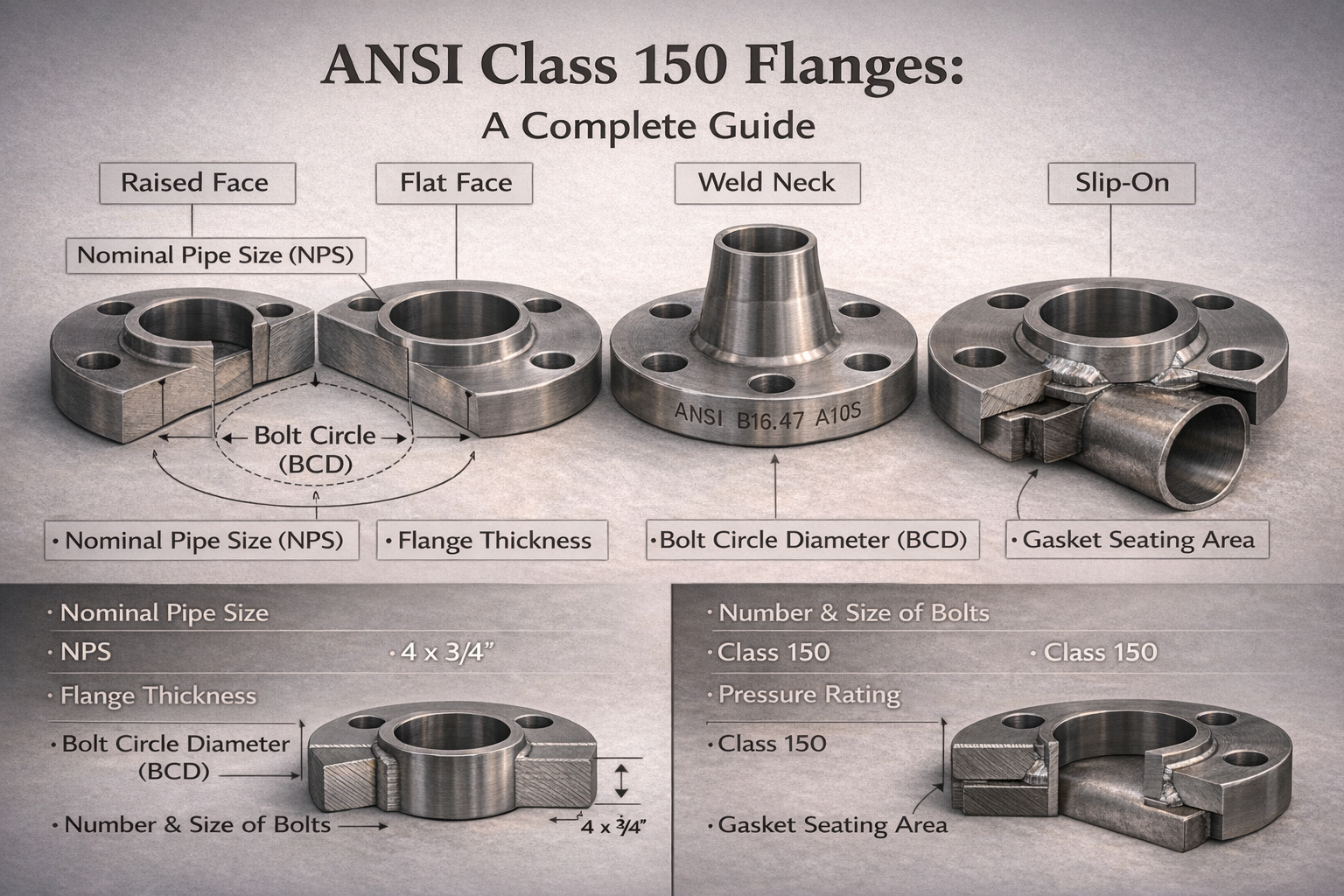
Common Types of Class 150 Flanges
You can get Class 150 flanges in several designs. Each type has a specific use. They share key connecting dimensions (like bolt holes) so they can fit together, but their shapes differ .
| Flange Type | How It Connects | Best Used For |
| Weld Neck (WN) | Butt-welded to the pipe. | High-stress systems, high temperature, or repeated bending . Strongest connection . |
| Slip-On (SO) | Slides over the pipe, welded inside and out. | Lower pressure, cost-sensitive jobs where alignment is easier . |
| Blind (BL) | A solid disk with no hole. | Closing off the end of a pipe or isolating a section for maintenance . |
| Socket Weld (SW) | Pipe inserts into a socket and is welded. | Small-diameter, high-pressure piping . |
| Threaded (THD) | Screws onto a pipe with matching threads. | Low-pressure systems where welding is not wanted or allowed . |
| Lap Joint (LJ) | Pairs with a stub end welded to the pipe. The flange is loose. | Systems needing frequent disassembly or easy bolt hole alignment . |
Key Dimensions for Class 150 Flanges
Standard dimensions ensure flanges from different suppliers can connect. The main dimensions are standardized from NPS ½” to 24″ .
Here are key dimensions for common sizes (in inches) :
| Nominal Pipe Size (NPS) | Outside Diameter (O) | Flange Thickness (T) | Bolt Circle Diameter | Number of Bolts |
| 1/2″ | 3.50 | 0.38 | 2.38 | 4 |
| 2″ | 6.00 | 0.69 | 4.75 | 4 |
| 4″ | 9.00 | 0.88 | 7.50 | 8 |
| 6″ | 11.00 | 0.94 | 9.50 | 8 |
| 10″ | 16.00 | 1.12 | 14.25 | 12 |
| 12″ | 19.00 | 1.19 | 17.00 | 12 |
| 24″ | 32.00 | 1.81 | 29.50 | 20 |
- Bolt Hole Diameter: This increases with size. For NPS 2″, holes are 0.75″. For NPS 12″, holes are 1.00″ .
- Raised Face: Most Class 150 flanges have a 1/16-inch raised surface for the gasket to improve the seal .
Material Selection and Applications
Class 150 flanges are made from many materials to handle different fluids and conditions.
- Carbon Steel (ASTM A105): Common for general use due to strength and cost .
- Stainless Steel (e.g., ASTM A182 F304/316): Used where corrosion resistance is needed .
- Alloy Steels: For specialized high-temperature or low-temperature service .
These flanges are used across many industries for low to moderate pressure systems. Common applications include water treatment, HVAC, fire protection, and general plant utilities .
Installation and Sealing Guidance
Proper installation prevents leaks. Here are key points.
- Clean Surfaces: Ensure flange faces are clean and free of debris before assembly .
- Gasket Selection: Choose a gasket material compatible with your fluid, pressure, and temperature .
- Proper Alignment: Align the bolt holes correctly. Misalignment causes uneven stress .
- Bolt Tightening: Tighten bolts evenly in a crisscross pattern to the specified torque . Avoid over-tightening.
Need help selecting or sourcing the right Class 150 flange for your specific pressure, temperature, and material requirements? Get a precise quote for your project here: http://texasflange.com/lp12/
Frequently Asked Questions
Q: Can I use a Class 150 flange for high-temperature service?
A: Yes, but you must reduce its pressure rating. Always consult the official ASME B16.5 pressure-temperature tables for your specific flange material .
Q: What’s the difference between a Class 150 and Class 300 flange?
A: The Class 300 flange is thicker, has a larger diameter, and more or larger bolts. It is rated for higher pressures at the same temperature . They are not interchangeable.
Q: What standards cover flanges larger than 24 inches?
A: For flanges NPS 26″ to 60″, the governing standard is ASME B16.47 .
Q: Are the dimensions the same for all flange types?
A: Yes, for connecting dimensions like bolt circle, number of bolts, and outside diameter. This ensures a weld neck can bolt to a blind flange. Other dimensions like hub length differ by type .
Conclusion
ANSI Class 150 flanges are versatile components for many piping systems. Success depends on understanding that their pressure rating changes with temperature, choosing the right type and material, and following proper installation steps.